A calligraphy brush looks simple, but once the Chinese brush or Japanese brush starts to move its tip, its expression reaches beyond the limits of the paper.
The play of the calligrapher with the calligraphy brush is often compared to the dance of a ballerina. Just like a ballerina moves the body to perform the choreography, the calligrapher maneuvers the calligraphy brush to shape infinity of calligraphic forms.
The calligraphy brush goes up, goes down, it bends; with more pressure it spreads, with less it regains its shape, and for each movement the calligrapher has to have the calligraphy brush under control and be able to return to a straightened brush tip. For this the artist needs a supple and resilient brush, as only such a tool can respond quickly and unfailingly to the subtle commands of her/his hand, and perform a flawless dance of interplaying brush movements.
Select the right brush for your practice of Japanese calligraphy
A calligraphy brush may have two or more layers, but for the sake of simplicity, we analyze the standard calligraphy brush with two layers: An inner core of shorter hairs, which form the belly of the brush, and an outer layer of longer hairs that make the tip of the brush.
A good Chinese calligraphy brush or Japanese brush should have four qualities:
SHARPNESS — The brush should have a fine tip and come easily to a point.
STRUCTURE — The longest hairs that make the tip of the brush should all have the same length and stay evenly together. No individual hairs should stick out.
RESILIENCE — The brush tip will only be able to react immediately to the pressure exerted by the calligrapher when there is a correct balance between supple and firmer hairs.
ROUNDNESS — The body of the brush should be full and round.
Chinese and Japanese use different types of animal hairs to make calligraphy brushes, mainly goat’s hair and wolf’s hair.
The goat’s hair calligraphy brush
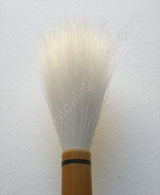 The goat’s hair brushes are white-haired brushes made from the hair of sheep, goats, cats or even deer. They are very absorbent and supple, and produce rounded forms and saturated fleshy brushstrokes.
This calligraphy brush is particularly suitable for the hidden brush tip technique, which requires many subtle bending movements of the brush tip.
The white-haired calligraphy brush is excellent for standard script, current and cursive script.
The wolf’s hair calligraphy brush
The wolf’s hair brushes are brown-haired brushes made from the hair of marten, horses, weasel or rabbits. This calligraphy brush is stiff and resilient and brushes sharp bony strokes. It is suitable for the direct attack technique of Japanese calligraphy that forms strokes with sharp beginnings and endings.
I use the brown hair brushes when writing smaller characters or when the aesthetics demands it. For instance, the long-haired horsehair calligraphy brush produces the flying white effect easily. In this technique the stiff horsehair splits easily and leaves white spaces in the brushstroke. Although the brush is a very helpful tool for achieving this effect, only a master calligrapher will be able to raise the brush in such a way that brings a pleasing result and prevent the brushstroke from looking harsh and broken.
The mixed hair calligraphy brush
The mixed hair or combination brushes are a special category. They are used very much in sumi painting. These calligraphy brushes are made from different types of animal hair, and combine brown and white hairs. The stiff brown hairs from the inner core of the brush are used for their resilient quality, while the outer white hairs ensure the suppleness of the brush tip.
I like to use a mixed hair calligraphy brush made from horse and goat’s hair to write the ancient seal script. This script has rounded forms but at the same time it needs a brush with a stiffer core to simulate the hardness of a knife that engraves a character in stone or bone.
For beginners I recommend a Chinese brush or Japanese calligraphy brush of goat or sheep’s hair of about 1.7″ or 4.5 cm in length.
The technique that you learn will determine if you begin with a hard or soft calligraphy brush. My advice is that you start with the hidden brush tip technique and a soft brush. At the beginning it is more difficult to handle it, but you will get a very solid basis that will allow you to work with any calligraphy brush.
How to take care of the calligraphy brush
A new brush is stiff because its hairs are covered with a layer of diluted glue to protect them from possible damage. Before you begin to use a new calligraphy brush you have to wash the glue away.
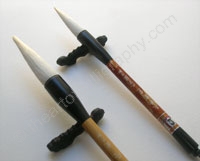 Put your hand under the flowing tap water and form a well with your palm. Place the brush tuft in this well and rotate it in the water that collects in your hand gently and without pressure. Do not put the brush directly under the tap water as you could damage the hairs. Soon you will notice that the tuft hairs start to loosen. Continue soaking and rotating the calligraphy brush until all hairs are fully loosened. Some calligraphers or sumi painters open the calligraphy brush only one third or two thirds. This depends on the type of hairs and the technique you use.
Do not leave the brush in a jar with water, because the weight of the calligraphy brush can break or damage the tip of the brush.
Take good care of your calligraphy brush, because the hairs are very delicate. After each session you should rinse your brush under tap water in the same way as when you open a new brush.
Pay attention to the ink, which remains in the belly of the calligraphy brush, press it out with soft movements from the belly of the brush towards the tip until there is no ink left in it. Then squeeze the brush gently and bring it to a pointed shape. Hang it with the tip down and let it dry well.
A calligraphy brush wears out when using it
When the brush has become less resilient and the brush tip has an irregular form, then it is time to get a new one. I do not throw old calligraphy brushes away. I bury them or keep them in a special box where they can rest out of respect for what they have done for me and the time we shared. The great Chinese painter Chang Dai-chien showed real love for his old brushes. He had a small tombstone in the garden in front of his art studio to memorialize his deceased paint brushes!
Buying a calligraphy brush
Click here for high-quality Chinese sumi painting brushes and calligraphy brushes.
At this reliable company you might find what you are looking for as they have an outstanding collection of mainly Chinese combined brushes and hard calligraphy brushes.
Chinese Calligraphy Brush Set
|
|


Buying A Japanese Kumano Brush
The city of Kumano in Japan, called the Capital Of Brushes, is worldwide renowned for the supreme quality of its brushes. Kumano brushes stand for high grade, top quality brushes, made with care and traditional Japanese craftsmanship. Some of the leading brands for Kumano brushes are for example, Shōgetsudō, Chōeidō, Hiroshima Artist Brush and Bunkōdō. If you buy one of these brushes and take care of them, they will last for a very long time.
If you are looking for high quality Japanese calligraphy brushes, please check out my selection of premium quality Kumano brushes.
|
|


Related pages
| Japanese calligraphy supplies | The ink stick | The ink stone |
| The rice paper | Chinese watercolors |
| Japanese calligraphy home | Shodo Art Gallery | Buddhist Art Scrolls |
| Kanji Art Gallery | About the artist | Sutra copying |
| Kanji symbols | Inspirational kanji t-shirts | Martial arts t-shirts |