Sized and unsized rice paper are the main types of rice paper used for sumi-e and calligraphy. I will describe their unique qualities, show how they react differently and explain what degree of mastery each requires.
Among artists of traditional Chinese and Japanese painting a constant discussion has been going on about how to best bring out the different ink shades in sumi painting. Mastery in brush handling is one of the requirements. Another one is the painting surface you choose. In order to achieve the expression you have in mind you should careful select the right sumi rice paper and know its characteristics.
Sized and unsized rice paper
Sumi-e painters and calligraphers use mainly two kinds of rice paper for their art performance.
The first one is unsized rice paper, sometimes called raw rice paper, which is absorbent with a soft but slightly coarse texture.
The second one is sized rice paper, which is less absorbent because it is coated with an alum solution. The texture is close and dry.
You can also find semi-sized rice paper which combines the qualities of both; still absorbent but less diffusive than sized rice paper.
Sized or unsized paper, what is the difference?
The biggest difference between both papers is their absorbency degree, which determines a very great deal the spirit and life of the brush work and ink play.
Unsized paper is best for spontaneous painting with bold and fast brush strokes in the abstract style, more like the Zen way or paintings of the Chinese Southern school.
It has an almost miraculous absorbency. But this is the tricky side of unsized rice paper. As it is highly absorbent, it requires a firm and experienced brush handling, fast movements of the brush, and a high moisture control, otherwise ink and colors will run. It responds highly to vigorous brush work with a soft sheep’s hair brush, displaying vivid, energetic and vibrant brush strokes.
It is the best sumi-e paper for one ink layer paintings. If used for multiple washes make sure that the last wash is almost completely or totally dry before you apply a new layer; in so doing you avoid bleeding.
Unsized rice paper has a yin quality. As it soaks the ink and colors deep into the paper, the ink shines inwardly, unlike sized rice paper where the colors stay on the surface.
For many calligraphers, raw rice paper is the best of papers, because it energizes the brush handling. As the brush touches the paper, it experiences a certain resistance on the slight rough texture of the unsized rice paper and this is the principle of a spirited interplay of brush with paper.
 I like to call unsized rice paper the enlightening rice paper, as it is truthful to the moment. It is the rice paper of genuine inspiration. But as it is usually the case, spontaneity requires technique and mastership, and to achieve this you need in turn time and perseverance. This does not mean you can not use unsized rice paper right from the very beginning of your apprenticeship. I do encourage you to do so, as the sooner you start working on unsized rice paper the earlier you will discover the mysteries of this paper.
The second sumi rice paper is sized rice paper. This rice paper is best for more detailed, delicate painting in a more academic style, where the brush work is done with slow and multiple strokes, more like the style of the Northern school of Chinese painting.
You need less experience in brush handling and moisture control as ink and colors do not blur. Even if you press too hard or stay too long on one spot colors will not run as they fix quickly on the paper. It therefore lends itself to multiple washes, which can easily be applied one after the other.
Its quality is yang. The ink does not penetrate the paper; it stays on the outside and shines therefore outwardly. The effect is thus cooler. As for the luminosity, colors are not as vibrant as on unsized paper because the alum coating tones the colors down.
Sized rice paper lends itself very well to small character calligraphy.
Sizes and thickness of rice paper
Rice paper for sumi-e and calligraphy can be found as individual sheets, rolls or as Japanese shikishi boards.
The large hand made individual sheets of rice paper come mostly in a standard size of about 27″ x 54″ (69 x 137 cm), although there are small variations between Japanese and Chinese sheets.
The rice paper rolls, which are rather narrow and long, contain about 10 sheets each and their size varies between 13.5″ x 27″ (34,5 x 69 cm) for small format and 18″ x 27″ (46 x 69 cm) for larger sheets.
Pre cut sheets are very useful for practice. Some of them have the standard format of the classic Chinese single or double album sheet: 9.25″ x 13.25″ (34,5 x 23 cm)or 18″ x 13.25″ (35 x 46 cm).
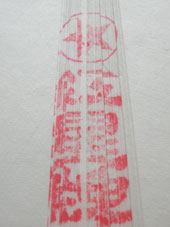
Red Star Rice Paper
Rice paper comes in different degrees of thickness. The most common are one-ply and two-ply rice paper sheets. For beginners one-ply rice paper can be frustrating to work with. An excellent alternative is two-ply paper which is in general less demanding. Especially in the case of unsized rice paper, if you do not have enough control of the brush and moisture, the ink or colors might blur. In this case, try two-ply unsized rice paper, the double thickness gives you an extra chance.
Where to buy rice paper ?
When you need rice paper, buy quality rice paper as this is the first condition for a good preservation of your artwork.
Here you can get rice paper. At this reliable company you will find a broad range of quality rice papers and blank scrolls.
Buy Premium Xuan Paper
 |
 |
 |
| Buy unsized xuan paper single ply |
Buy unsized xuan paper double ply |
Buy assortment pack of single, double and triple unsized xuan paper |
Buy Red Star Xuan Rice Paper, The Best Chinese Xuan Paper

Buy Small Xuan Rice Paper Sheets for Practice
|
|
|


Buy Xuan Rice Paper Large Sheets
|
|
|
|


Related pages
| The ink stick | The ink stone | The calligraphy brush |
| Japanese calligraphy supplies | Chinese watercolors |
| Japanese calligraphy home | Shodo Art Gallery |Buddhist Art Scrolls |
| Painting gallery | Kanji Art Gallery | About the artist | Sutra copying |
| Kanji symbols | Inspirational kanji t-shirts | Martial arts t-shirts |