The Seven Virtues of Bushido come alive in this calligraphy of the Bushido Code: gi, yuuki, jin, rei, makoto, meiyo and chuugi, the Seven Virtues of Bushido, are brushed in dynamic Japanese kanji.
Japanese calligraphy in standard script
Read from top to bottom, and from right to left.
Japanese Calligraphy and Bushido
As a Japanese calligraphy artist my attention was drawn upon bushido by Yamaoka Tesshu, the great swordsman of the 19th century Japan, who still inspires many martial artists, both in Japan and the West.
Apart from being a Master of the Way of the Sword and Zen, he was also a supreme calligrapher, a Master of the Way of the Brush. I admire his calligraphy, full of life and strength, and trying to find out what forged the spirit of this strong personality I find two decisive factors: On the one hand his Zen training and enlightenment and on the other hand bushido. As he says:
As a samurai, I must strengthen my character;
As a human being, I must perfect my spirit.From The Sword of No-Sword, Life of the Master Warrior Tesshu. John Stevens
What are the Seven Virtues of Bushido?
To understand truly what bushido and its education, the Seven Virtues of Bushido, meant for a samurai of the feudal Japan one needs some help. I have found the reading of Inazo Nitobe’s book Bushido, The Soul of Japan most enlightening and I strongly recommend this book to every martial artist who wants to understand the true Bushido Code.
In feudal Japan The Seven Virtues of Bushido were the code of moral principles followed by the samurai, an ethical code of conduct that permeated life, from childhood to old age, often not even written, but carved in the heart of the samurai.
 As Inazo Nitobe defines it: Bushido means literally the military-knight ways – the ways which fighting nobles should observe in their daily life as well as in their vocation; in a word, the precepts of knighthood.
What characterized these samurai and supported their action and knowledge of right and wrong is what we now popularly call the Bushido Code or the Seven Virtues of Bushido. Some of the virtues such as benevolence, politeness and truthfulness are inspired by the teachings of Confucius and Mencius. In his chapter on the Sources of Bushido Inazo Nitobe mentions that the writings of these Chinese philosophers were the principal text-books for the youth and the highest authority of discussion among the old.
The Kanji of the Seven Virtues and their Spirit
The kanji you find here may differ from the characters seen in other websites.
I present the Bushido Code as discussed by Inazo Nitobe, and have found the following kanji the most appropriate to represent its spirit. The seven virtues follow each other in a very specific sequence, as each complements the other.
1. GI – Right Action, Duty
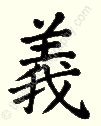 Gi has two parts: the upper part represents a sheep, which was the symbol of beauty in ancient China and the lower part is the character for I, with a strong slanting stroke on the left which represents a halberd. The character could be explained as understanding (sheep) after conflict (halberd).
Gi is to do the right thing.
2. YUUKI – Courage
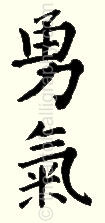 Yuuki has two kanji. The first is yuu, which means courageous, with the important component of chikara, the symbol for strength.
The second kanji is ki or energy.
Yuuki means brave, courageous energy.
3. JIN – Benevolence
 Jin has two parts: on the left side stands the character for human, and on the right there are two horizontal strokes which represent the number two. Jin is one of the most fundamental virtues of Confucianism, which could be defined as to treat each other with tenderness, to love each other.
Jin is the benevolence that unites each human being to the other.
4. REI – Politeness or Morality
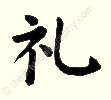 The kanji for rei is a modern abbreviated form, which does not reveal very much of the ancient character. The ancient symbol shows a sacrificing vessel that evokes the rites and ceremonies conducted for worshipping and offerings. The character actually means rite or ceremony but in a broader sense it means respect.
Rei too is essential to Confucianism: In society rei governs your actions towards others, a fundamental politeness, very much related to jin.
It is often translated with morality, but as morality has other connotations I suggest politeness.
Rei is politeness, respect shown in social behavior.
5. MAKOTO – Truthfulness
 The kanji for makoto is composed of two parts: at the left stands the character for to speak, a mouth that produces words. At the right stands the character sei, which means to accomplish, to succeed.
Makoto means truth in word and action, to follow truly the Law of the Universe.
6. MEIYO – Honor
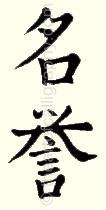 Meiyo has two kanji. The first is mei, which means reputation, with the symbol of mouth below. The second kanji is yo, which means to praise or to admire, which has the component of to say.
Meiyo is to enjoy a good reputation, honor.
7. CHUUGI – Loyalty
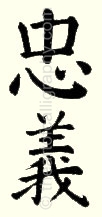 Chuugi has two characters. The first one is chuu which means to be sincere or loyal. This character expresses very well the true meaning of loyalty. We see a heart and on top of it the symbol for middle. Chuu could be understood as no conflict in the heart, faithful to what is felt in the heart.
The second kanji is gi, which means right action or duty.
Chuugi is to act faithfully, to be loyal.
Buy a Seven Virtues of Bushido Samurai Code Print
The Seven Virtues of Bushido have inspired me as an artist and I have brushed them in different styles of Japanese calligraphy. As I explained above, each kanji covers in a visual way the content of a virtue and through the living energy of the calligraphic brushstrokes they become dynamic images.
I have designed a collection of original hand-brushed Bushido Samurai code prints with bright kanji designs for the martial artist. I hope you enjoy the Bushido code calligraphies and use them as visual support in everyday life and for your training.
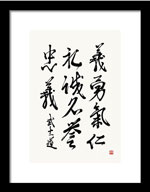
If you want to buy a Bushido Code Print you can select from our collection of Bushido Code premium prints. Premium prints are available as framed print, canvas print, metal print and acrylic print.
An inspirational martial arts gift for bushido practitioners!
 |
 |
 |
| Bushido Code Print Seven Virtues Regular Style |
Bushido Code Print Seven Virtues Semi-cursive Style |
Bushido Code Print Seven Virtues Cursive Style |
Buy a Bushido Code T-shirt
Below you can see some examples of our original Bushido Code T-shirts with the Seven Virtues of Bushido brushed in different styles of Japanese calligraphy.
|
|
|


|
|
|


|
|
|


Popular Pages Featuring Martial Arts Calligraphy
| Martial Arts T-shirts |
| Bushido Kanji | Aikido Kanji | Ninja Kanji |
| Japanese Calligraphy Home | Shodo Art Gallery |
| Buddhist Art Scrolls | Zen Art Gallery | Japanese Painting Gallery |
| About the Artist | Sutra Copying | Sutra Kanji Course |
|Japanese Calligraphy Supplies | Kanji T-shirts |